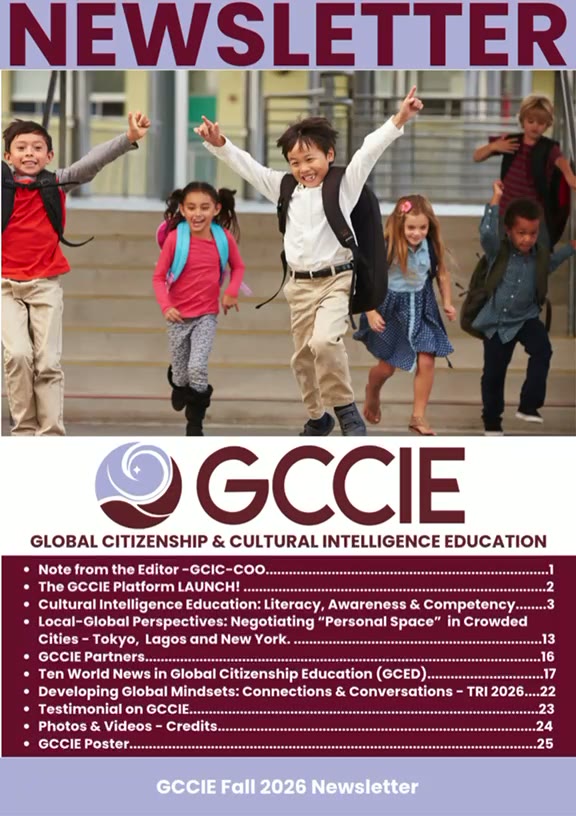
GCCIE Fall 2026 Newsletter
A New Dawn for Global Citizenship and Cultural Intelligence Education.
Our very first newsletter: the GCCIE platform launch, cultural intelligence in the classroom, local-global perspectives from Tokyo, Lagos and New York, and the latest world news in global citizenship education.
Newsletter Video · narrated
Download MP4Every page of the newsletter, read aloud and held on screen for as long as it takes.
Newsletter PDF
Listen to the Newsletter
Download MP3The whole issue read aloud, page by page · about 17 minutes.
Read along
- Cover
GCCIE Fall 2026 Newsletter. Global Citizenship and Cultural Intelligence Education.
In this issue: a note from the editor; the GCCIE Platform launch; Cultural Intelligence Education, on literacy, awareness and competency; local-global perspectives on personal space in Tokyo, Lagos and New York; our partners; ten world news stories in global citizenship education; developing global mindsets at TRI 2026; and testimonials.
- Credits
© 2026 GCIC and GCCIE. All rights reserved. Registered trademark of Global Cultural Intelligence Consulting, Casablanca, Morocco.
Many thanks to Aya Mhanna, our spring 2026 design intern from Al Akhawayn University in Ifrane, Morocco, for the initial design and formatting of this newsletter.
- p. 01
A note from the editor, Dr. Séverine Minot. A new dawn for global citizenship and cultural intelligence education.
It is with immense pride that I present you with the very first GCCIE newsletter. I've had the privilege of witnessing GCCIE evolve from an ambitious idea into a revolutionary teaching and learning platform, designed to make Global Citizenship and Cultural Intelligence Education more accessible, practical, measurable, and engaging.
September first, 2026, marked the launch of the GCCIE digital ecosystem; for us, the culmination of three years of hard work, driven by our mission to ensure that the next generation of leaders are prepared for a globally connected future.
- p. 02
The GCCIE Platform launched on September first, 2026. Individual student and school subscriptions are now available at a discounted price. GCCIE is the only all-in-one platform designed to help kindergarten to grade twelve students and schools effortlessly embed Global Citizenship and Cultural Intelligence Education into every grade and subject, while also maximizing student independent learning.
It offers a growing database of curated educational content in four streams: global citizenship, international studies, cultural studies, and institutional capacity building. Multi-modal gamification, with XP, medals and certificates. An LMS with easy grading and AI generated quizzes. And school-wide performance dashboards for administrators.
Book a free online demo session: info at GCCIE dot net.
- p. 03
Cultural Intelligence Education: Fostering Literacy, Awareness and Competency, by Nourane Harbaz and Séverine Minot.
Cultural literacy, cultural awareness, cultural competency, and cultural intelligence are usually thrown around without distinction, often used as synonyms. The distinction is, however, quite important, given the need to inform teaching strategies and establish clear learning objectives, as well as measures of progress in the field of education.
Cultural literacy refers to the accumulation of knowledge about a culture. In the context of Global Citizenship and international education, it is often framed as cross-cultural literacy, intercultural literacy, or even foreign cultural literacy.
- p. 04
Cultural literacy is the lifelong and ongoing cumulative knowledge that is needed to understand the common and shared frames of reference of social groups, our own, and those of others. It entails developing knowledge about one's own culture and about other cultures around the world, and an awareness of cultural similarities and differences.
Cultural literacy is the bedrock of cultural intelligence. It is a foundational pillar of cultural intelligence education. As students learn about their own culture, and hopefully about different cultures around the world, they access insights that inevitably deepen their understanding of global and local realities.
- p. 05
Without basic exposure to others and their frames of reference, people usually rely on limited information, and superficial exposure might produce and reproduce forms of bias, prejudices and stereotypes. Cultural literacy is the first step to challenge stereotypes and prejudices.
The more culturally literate a student becomes, the greater their awareness. Cultural awareness serves as the attitude pillar: the propensity to make sense of the world beyond the default prism of one's own culture. This stage of the cross-cultural journey is founded on critical self-reflection, recognizing the conscious and unconscious biases people hold about others, as well as one's own.
- p. 06
With cultural awareness, students can begin to develop competencies. One has to know about chopsticks, and what they are used for and how, to then try simulating the grip with two pencils at school, and then, becoming good at using real chopsticks to eat noodles.
Cultural competency is the skill pillar, which entails the ability to adapt and perform effectively in cross-cultural contexts. It takes many forms, from language skills to the capacity to act and react in alignment with cultural norms and values. It demands resourcefulness, authenticity and the capacity to learn and adapt, and it is a core component behind cross-cultural leadership.
- p. 07
In time, with cumulative learning and growing insights of cultural literacy, cultural awareness develops; and, with opportunities to engage with different practices, this awareness spurs on the acquisition of cultural competencies.
With the ability to understand, compare and contrast, to adapt, engage and perform effectively in varied cultural settings, students are bound to develop Cultural Intelligence, also known as CQ. CQ represents the flexibility pillar: the ability to cope smoothly in culturally diverse contexts. CQ is necessary to tackle the global challenges that we are facing, as people across cultural backgrounds are called to work and live together. This is why CQ is a keystone of Global Citizenship.
- p. 08
The playbook of best practices is not yet written, but there are loads of amazing teachers with great ideas around the world. Making these relevant to the everyday rhythms of the classroom, across grades and subjects, demands innovative thinking, and this requires us to move from theory to practice.
Teachers are brokers of cultures; they are intermediaries between learners, local cultures, and other imagined communities. Another compounding challenge is that the onus falls disproportionately on teachers, who are often already stretched thin. While AI is increasingly used by teachers to develop course content, it still takes time to fact check, curate, and edit content.
- p. 09
Teachers can't do it without a broader, coordinated institutional commitment. Effective implementation of CQ education best practices entails working with administrators and program coordinators, to establish an ongoing multiyear strategy that is cumulative from kindergarten to grade twelve.
However, there still exists an enormous gap in the educational system, as the pedagogical training which educators receive often does not include cross-cultural literacy, awareness or competence. Most schools fall short of offering a multiyear CQ education framework with measurable and cumulative learning outcomes, year on year.
- p. 10
In order to bring K to 12 cultural intelligence education to the next level, we have to reconsider old and outdated strategies. It is no longer sufficient to hold occasional international day events, to engage only a handful of students in programs like Model United Nations, or to have an international faculty body.
Regular exposure to cross-cultural content across subjects, as well as gamified and structured cumulative learning from kindergarten to grade twelve, represents a more holistic solution. The GCCIE platform, launched on September first, 2026, offers an interactive experience that will enable teachers to save time, keep students engaged with incentives and reward systems, and provide measurable educational outcomes.
- p. 11
In turn, accreditation bodies benefit from a set of standardized tools that render clear data on school-wide engagement with global citizenship and cultural intelligence content.
Imagine a schoolwide system with LMS functionalities, offering access to curated content organized by topic, with intuitive assignment management, easy homework submission, and speedy grading, layered with educational gameplay and performance rewards. We designed the GCCIE platform with all this in mind, but we also wanted to make it fun for kids and teens to learn about the world, while providing capacity building tools for teachers and administrators.
- p. 12
Sources. The references for this article are listed on this page.
- p. 13
Local-Global Perspectives. Negotiating personal space in crowded cities: Tokyo, Lagos and New York, by Alyssa Kleinert.
How close is too close? If you put more than ten million people in one place, what happens to personal space? That would depend entirely on where in the world you are.
Tokyo, Japan: quiet proximity. At rush hour, Tokyo's trains are packed shoulder to shoulder, but you might be surprised to find silence. Phones are on silent, conversations are minimal and left to low whispers, and eye contact is limited. Tokyo shows us that personal space isn't necessarily physical but can also be behavioural.
- p. 14
Lagos: energy is the space. Lagos is one of Africa's largest and fastest-growing cities, with an estimated seventeen to twenty-two million residents in 2026. Differing from Tokyo, Lagos thrives on interaction. Space is shared both loudly and openly. You might catch strangers joking and engaging with one another.
Lagos does not consider physical closeness invasive, but rather communal. People chat and laugh loudly, and call out to each other from a distance. Anyone could potentially start a conversation with you.
- p. 15
New York: bubble in a crowd. Commuters are in their own bubble despite close proximity, and people generally respect each other's invisible boundaries. New Yorkers don't consider this unfriendly by any means. Interactions with strangers are mainly purposeful, rather than random. But if you need help with directions, people are quick to step in.
It's all relative! Different cultural norms prevail in cities of similar size and social density. Cultural Intelligence is about knowing what to expect, negotiating differences with ease, and appreciating the learning that comes with cross-cultural agility.
- p. 16
Meet our GCCIE partners.
- p. 17
Top ten news in Global Citizenship Education, by Mohamed Hachnaoui. This article highlights ten significant initiatives, which reflect innovation, impact, and international collaboration.
Number one: UNESCO announces the first Global Citizenship Education Prize laureates. Among the winners were a youth-led peace initiative in Tanzania, and a school program in Ecuador that connects learning with life in the Amazon. Selected from over one hundred fifty nominations across seventy-six countries, each winner received fifty thousand dollars.
Number two: the twelfth Youth Leadership Workshop on GCED took place in Seoul, South Korea, connecting global issues such as climate change, human rights, and digital literacy with local action.
- p. 18
Number three: UNESCO strengthens GCED through regional peace and citizenship courses. An online training course for Latin America and the Caribbean brought together over two hundred educators, policymakers, and civil society representatives, addressing social polarization, conflict resolution, and intercultural dialogue.
Number four: digital citizenship and the future of education were debated at the Maastricht Symposium. The discussions focused on misinformation, responsible social media use, and participation in online spaces. Digital citizenship is no longer optional but is becoming a core component of education.
- p. 19
Number five: pedagogical debate gains ground to enhance GCED competencies. A study in Frontiers in Education highlighted how debate and problem-based learning are increasingly used. Students were not simply memorizing information; they were analysing, questioning, and forming their own perspectives.
Number six: a global summit on empathy and citizenship education was held in the United Kingdom. It reflected a growing understanding that being a global citizen is not only about knowledge, but also about how individuals relate to others and act with awareness and responsibility.
- p. 20
Number seven: Irish Aid launches a GCED grant scheme for 2026, offering support to organizations working on education and social development projects. These grants were not only about ideas, but about funding concrete projects capable of influencing communities.
Number eight: a national initiative in Lebanon, the School of Citizenship. With the support of UNESCO, Lebanon introduced the initiative to integrate global citizenship into its national education system, focusing on peace education, human rights, and sustainable development.
- p. 21
Number nine: international university collaboration strengthens GCED skills. Khon Kaen University partnered with the University of Tsukuba through the CAMPUS-Asia program, allowing students to experience different cultures directly and work together on shared projects.
Number ten: a regional education forum in Jordan highlights citizenship values. The Educating for Tomorrow forum, hosted by the Queen Rania Teacher Academy, brought together educators and policymakers from over seventy countries to discuss the future of citizenship education.
- p. 22
GCCIE at the Tri-Association Educators Conference in the Dominican Republic. Andrew Frezludeen, GCCIE Co-Director, attended TRICON 2026. Developing global mindsets: connections and conversations at TRI 2026.
One message that really stood out was the recognition that one-off events and activities are not enough to develop global mindsets, intercultural awareness and Cultural Intelligence. Many educators saw the need for a more intentional, sustained approach, one that can become a daily habit. Many saw GCCIE's eight to twelve minute daily routine as a practical way to make that happen.
- p. 23
Testimonials on the GCCIE platform. What teachers say: Students demonstrated curiosity and critical thinking. Students showed enthusiasm during the Challenge Mode activities and actively participated in class discussions. The modules promoted cultural understanding and encouraged students to make global connections.
What students say: I really like the platform because now we have badges and levels. It makes learning feel like a game and motivates me to log in from home on my own! I enjoyed the quizzes because they felt like a game. It made me want to keep trying and do better!
What GCCIE content development interns say: I just learned to be careful with a lot of things regarding others' cultures and beliefs; my overall sensitivity and awareness is something I can strongly feel now.
- p. 24
Photo and video credits. Images in this newsletter are licensed through Canva Pro. The photo on page one is by Séverine Minot, and the photo on page twenty-two is by Andrew Frezludeen.
- p. 25
Global Citizenship and Cultural Intelligence Education. Book a free demo session: info at GCCIE dot net. We're excited to share knowledge, inspire learning, and grow together!
Inside This Issue
- 1Note from the Editor
- 2The GCCIE Platform LAUNCH!
- 3Cultural Intelligence Education: Literacy, Awareness & Competency
- 13Local-Global Perspectives: Negotiating "Personal Space" in Crowded Cities - Tokyo, Lagos and New York
- 16GCCIE Partners
- 17Ten World News in Global Citizenship Education (GCED)
- 22Developing Global Mindsets: Connections & Conversations - TRI 2026
- 23Testimonial on GCCIE
- 24Photos & Videos - Credits
- 25GCCIE Poster
See GCCIE in Action
The GCCIE platform launched on September 1st, 2026. Book a free online demo session or read our Launch Brochure.